


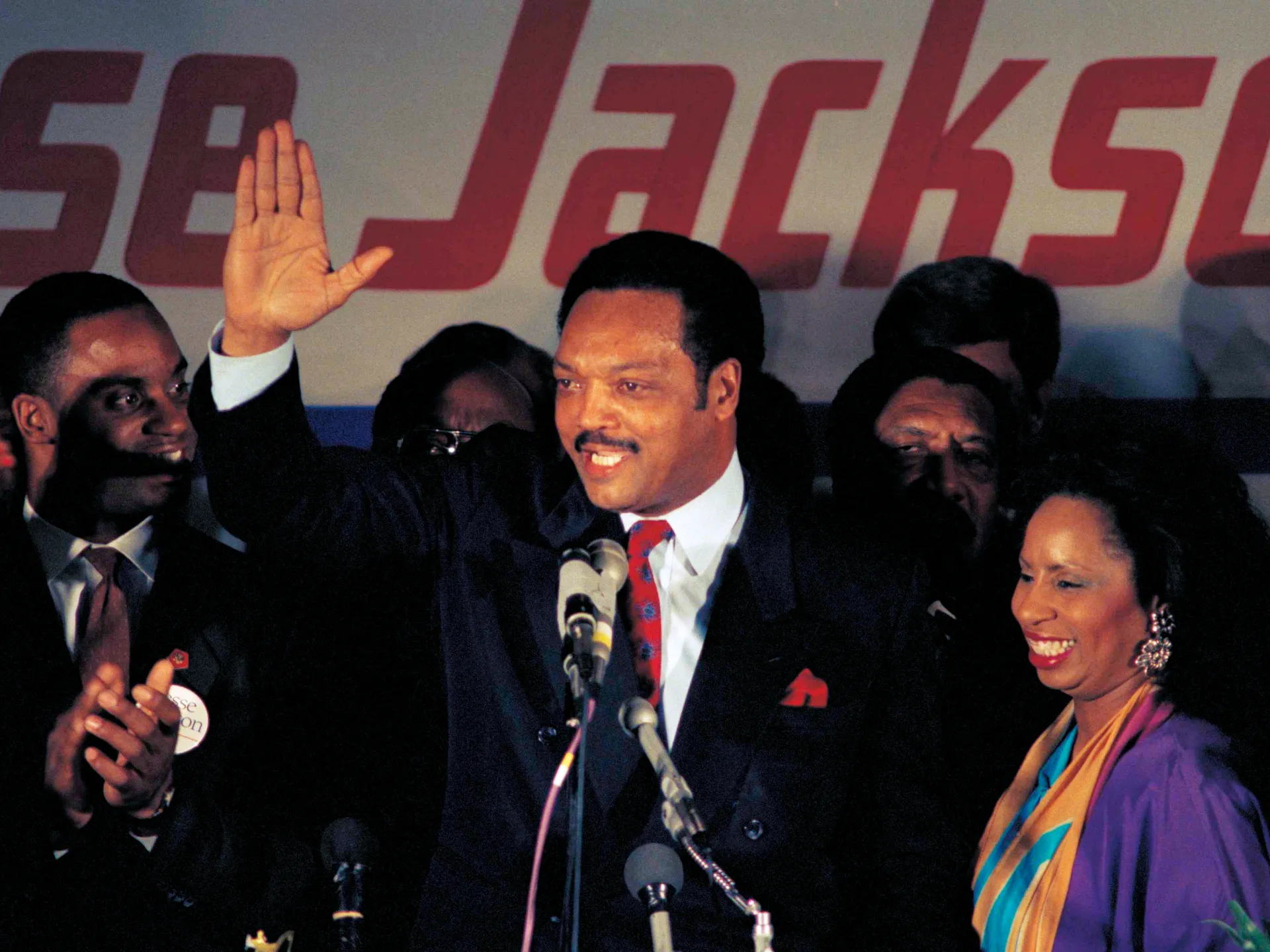
More than four decades ago, US civil rights leader Jesse Jackson urged the Democratic Party to broaden its inclusivity and welcome communities that felt excluded, marginalised, or overlooked. Among those he consistently embraced were Arab Americans and advocates for Palestinian rights, groups that had long faced discrimination, political marginalisation, and negative stereotyping in the United States.
Following Jackson’s death at the age of 84, advocates and community leaders have reflected on the role he played in helping elevate Arab American political engagement and bringing the Palestinian issue into mainstream political discussions.
Opening Political Space for Arab Americans
Community leaders say Jackson’s political campaigns in the 1980s marked a turning point for Arab American visibility in national politics. Maya Berry, executive director of the Arab American Institute (AAI), noted that it is difficult to separate the story of Arab American political empowerment from the path Jackson helped create.
During his 1984 presidential bid, Jackson appointed Arab American activist James Zogby as a deputy campaign manager, a move widely seen as groundbreaking at the time. Zogby later went on to establish the Arab American Institute, which became a key organisation advocating for Arab American representation and policy engagement.
Jackson’s campaign actively engaged Arab American communities and publicly acknowledged calls for Palestinian self-determination, at a time when US political discourse largely avoided such positions and maintained strong, unquestioned support for Israel.
Advocates say Jackson resisted pressure to distance himself from Arab Americans who viewed Palestine as a central issue, instead framing their concerns within his broader message of justice and equality.
Bringing Palestinian Rights Into National Discourse
Jackson’s second presidential campaign in 1988 further amplified these issues on a national stage. Although he ultimately lost the Democratic nomination to Michael Dukakis, his campaign succeeded in pushing discussions about Palestinian rights into party debates and political platforms.
Delegates aligned with Jackson, including Zogby, advocated for language supporting Palestinian statehood at the Democratic National Convention. While the proposal was not fully adopted at the national level, several state party platforms incorporated statements recognising the Palestinian people’s right to safety, self-determination, and an independent state.
His campaign also helped pave the way for greater Arab American representation within party structures. Ruth Ann Skaff, an Arab American activist from Texas, was appointed to the Democratic National Committee, despite facing criticism and accusations tied to her pro-Palestinian views. She later credited Jackson’s leadership with encouraging grassroots political participation and community organising.
Coalition Building and Civil Rights Roots
Born in South Carolina in 1941 during the era of racial segregation, Jackson became deeply involved in civil rights activism from a young age. A protégé of Martin Luther King Jr., he later moved to Chicago and founded the Rainbow/PUSH Coalition, a movement focused on social justice, civil rights, and community empowerment.
A key pillar of Jackson’s political philosophy was coalition building across diverse communities. Under his leadership, Black, Latino, Asian, Arab, and other groups worked together on issues of racial, economic, and social justice.
Leaders within Arab American organisations in Chicago and beyond have said that Jackson consistently opened political and civic spaces to Arab and Palestinian voices, particularly through the Rainbow/PUSH Coalition’s outreach efforts.
Continued Advocacy for Arab and Palestinian Issues
Jackson remained engaged with Arab and Palestinian causes long after his presidential campaigns. Community figures such as Nabih Ayad of the Arab American Civil Rights League described him as one of the earliest national leaders to highlight Palestinian concerns in mainstream political forums.
In addition to advocacy related to Palestine, Jackson also supported broader humanitarian issues affecting Arab communities. For example, he publicly backed efforts to resettle Syrian refugees in the United States in 2015, despite political opposition in several states.
In more recent years, his organisation convened discussions calling for a ceasefire during the Gaza conflict and he voiced support for pro-Palestinian student protests, framing them as part of a wider struggle for justice and human rights.
Political Risks and Lasting Influence
Scholars and community advocates note that supporting Palestinian rights often carried significant political risks in US politics, where such positions were frequently viewed as controversial. Matthew Jaber Stiffler of the Center for Arab Narratives said Jackson’s willingness to address these issues made many in the Arab community feel acknowledged and represented.
Even expressing basic support for Palestinian rights in national political spaces could lead to marginalisation, he explained, which made Jackson’s stance particularly notable during his political career.
A Changing Yet Challenging Political Landscape
Over time, discussions about Palestine have become more visible in US political and public discourse, with elected officials, activists, and public figures increasingly engaging with the topic. However, both major political parties have largely maintained strong pro-Israel platforms, and US military and financial support for Israel has continued.
Advocates also point to ongoing political challenges, including restrictions and pressures faced by pro-Palestinian activists in recent years. Despite these difficulties, community leaders say Jackson’s legacy offers a framework for continued civic engagement and advocacy.
A Legacy of Inclusion and Collective Action
Supporters argue that Jackson’s enduring message centred on unity, civic participation, and empowerment for marginalised communities. His encouragement for Arab Americans to organise, vote, run for office, and speak publicly about their concerns helped shape a generation of political activism.
Community leaders say his work demonstrated that advocacy for justice should persist even in difficult political climates. By integrating Arab American voices into broader civil rights coalitions, Jackson helped establish a lasting foundation for political participation and representation.
As tributes continue, many within Arab American and Palestinian advocacy circles remember Jackson not only as a civil rights icon, but also as a figure who consistently championed inclusion and gave space to voices often excluded from mainstream political conversations.