


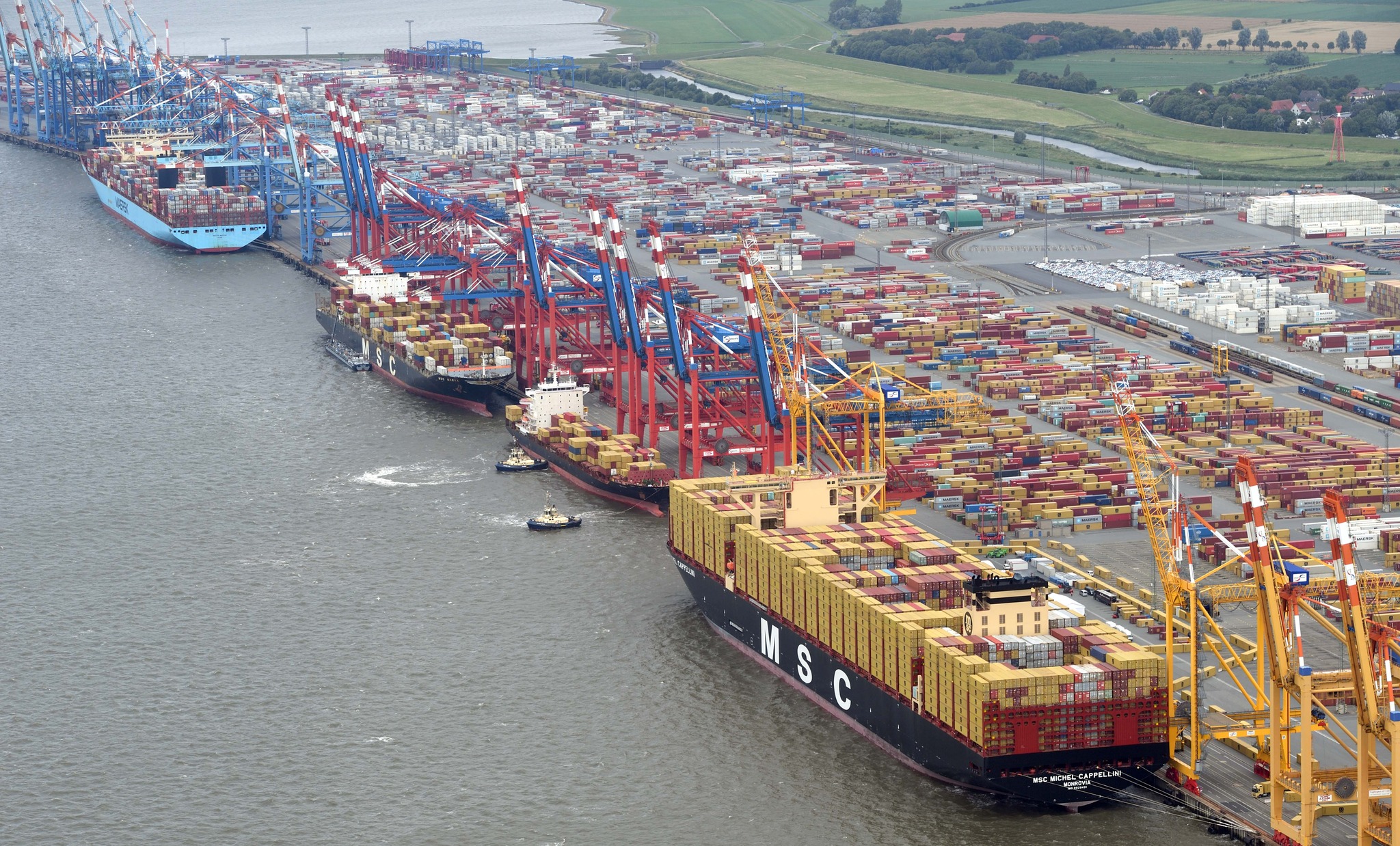
The world’s largest container shipping company has played a key role in transporting goods linked to Israeli settlements in the occupied West Bank, according to a joint investigation by Al Jazeera and the Palestinian Youth Movement (PYM), highlighting a gap between international legal obligations and trade practices in the United States and Europe. The Switzerland-based Mediterranean Shipping Company (MSC) has repeatedly shipped cargo originating from companies operating in Israeli settlements considered illegal under international law, based on commercial records drawn from U.S. import databases.
Hundreds of Shipments Tracked
Bills of lading reviewed in the investigation show that between January 1 and November 22, 2025, MSC handled at least 957 shipments from settlement-linked exporters to the United States. Of those, 529 shipments passed through European ports.
Spain accounted for the majority of EU transits, with 390 shipments, followed by Portugal (115), the Netherlands (22) and Belgium (2).
The data captures only a portion of the overall trade, as export records from Israel and most European countries are not publicly accessible. Still, the documents point to a heavy reliance on European ports and global shipping networks to move settlement-produced goods ranging from food and cosmetics to textiles, stone products and industrial materials.
MSC is privately owned by Italian billionaire Gianluigi Aponte and his wife Rafaela Aponte-Diamant.
Legal and Ethical Concerns
“Israeli settlements are widely regarded as illegal under international law because they are built on occupied territory,” said Nicola Perugini, a senior lecturer in international relations at the University of Edinburgh. “Commercialising products from those settlements effectively helps sustain an unlawful situation.”
Perugini added that states have a responsibility to prohibit such trade entirely, arguing that economic normalisation enables the continuation of occupation.
Under international law, including the Fourth Geneva Convention, the transfer of an occupying power’s civilian population into occupied territory is prohibited.
US and EU Policy Divide
The investigation comes amid contrasting international approaches to Israeli settlements. Under U.S. President Donald Trump, Washington reversed long-standing policy in 2019 by declaring settlements not inherently illegal, a position it maintained following Trump’s return to office in 2025.
The European Union, by contrast, does not recognise Israeli sovereignty over the settlements and has repeatedly described them as an obstacle to peace. However, shipping records show goods moving directly from European ports to settlement addresses.
In 2025 alone, MSC facilitated at least 14 shipments originating from Italy, with cargo leaving the Adriatic port of Ravenna and listing Israeli settlement names and postal codes as destinations.
This activity appears to contradict a 2024 advisory opinion from the International Court of Justice, which stated that third states are obliged to prevent trade or investment that supports Israel’s occupation of Palestinian territory. While the opinion does not directly regulate private corporations, it sets a legal benchmark for state responsibility.
UN and Corporate Responsibility
In April, the UN Human Rights Council urged companies to halt activities that contribute to the maintenance or expansion of Israeli settlements or the exploitation of occupied land.
A separate EU directive adopted in 2024 requires large companies operating in the bloc to identify and address adverse human rights impacts across their supply chains.
PYM previously reported similar findings involving Danish shipping firm Maersk, which has since said it is reviewing its screening processes to align with UN and OECD guidelines.
MSC told Al Jazeera it “respects global legal frameworks and regulations wherever it operates” and applies this policy to all shipments involving Israel.
Despite heightened security risks after Israel launched its war on Gaza in October 2023, MSC said it absorbed increased insurance costs rather than imposing war-related surcharges. The company also maintains vessel-sharing and cooperation agreements with Israel’s publicly traded shipping line ZIM.
Settlement Economy and Expansion
According to UN estimates, Israeli settlements in Area C of the West Bank and in occupied East Jerusalem generate around $30 billion annually for Israel’s economy. Area C covers more than 60 percent of the West Bank and remains under full Israeli control.
Meanwhile, the Palestinian economy has suffered severe losses. The UN estimates cumulative damage of roughly $170 billion between 2000 and 2024, driven by movement restrictions, land confiscation and barriers to trade.
Israel has recently accelerated settlement construction, including the controversial E1 project near Maale Adumim, which critics say could sever Palestinian territorial continuity and isolate East Jerusalem. The plan includes approximately 3,500 housing units.
Israeli Finance Minister Bezalel Smotrich has said the project would effectively end prospects for a Palestinian state.
Companies Identified in Shipments
The investigation found MSC transported goods for multiple companies operating from settlements listed in a UN database maintained by the Office of the High Commissioner for Human Rights.
These include Extal, an aluminium solutions firm with ties to Israeli defence manufacturers Israel Aerospace Industries and Rafael Advanced Defense Systems, as well as Maya, a wholesale supplier based in the Mishor Adumim industrial zone.
Other shipments were linked to Ahava Dead Sea Laboratories, a cosmetics brand long criticised over its use of natural resources from occupied territory.
Many shipments originated from the Barkan Industrial Zone, built on confiscated Palestinian land and associated with the fragmentation of nearby Palestinian communities.
European Debate Intensifies
In June, nine EU member states urged the European Commission to propose measures to halt trade with settlements, warning that current policies risk perpetuating an illegal situation. The Commission has yet to act.
While settlement goods can enter the EU, they are excluded from preferential tariffs under the EU–Israel Association Agreement and must be labelled as originating from settlements, following a 2019 EU court ruling.
Some states have gone further. Spain and Slovenia banned settlement imports in 2025, while Ireland, Belgium and the Netherlands are drafting similar legislation. However, Spain’s ban does not explicitly cover transshipments through its ports.
Bills of lading show the port of Valencia alone handled 358 settlement-linked shipments transiting Spain.
Ongoing Scrutiny
Hugh Lovatt, a senior policy fellow at the European Council on Foreign Relations, said EU policy ultimately hinges on political will.
“There is a clear legal basis for action,” he said. “Whether governments act on it is a political choice.”
As scrutiny of corporate supply chains intensifies, the findings raise renewed questions about how global trade networks intersect with international law—and whether companies and governments are willing to close the gap between legal principles and commercial practice.