


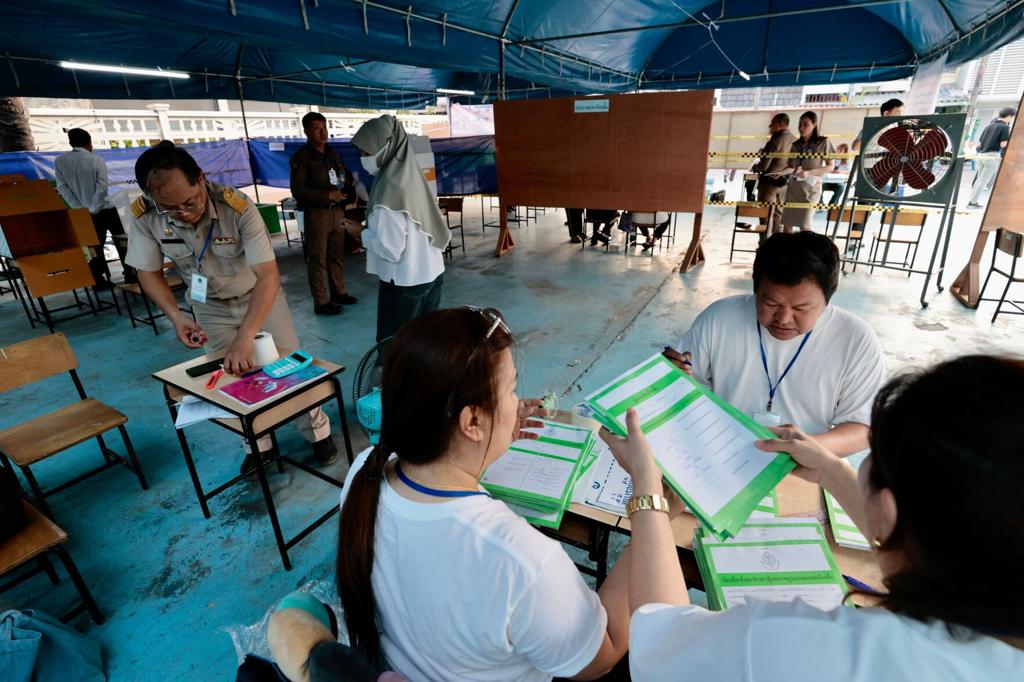
Thailand went to the polls on Sunday in a closely watched general election, with progressive reformers and military-aligned conservatives competing for control in a nation that has seen three prime ministers in just three years.
Voting began at 8:00 a.m. local time and is scheduled to conclude at 5:00 p.m., with early indications pointing to another divided parliament and complex coalition negotiations ahead.
More than 50 political parties are contesting the election, but only three are widely viewed as capable of securing a nationwide mandate: the People’s Party, Bhumjaithai, and Pheu Thai.
With 500 seats in the House of Representatives at stake and opinion surveys suggesting no single party will secure an outright majority, coalition-building is expected to determine who forms the next government. The prime minister will be chosen by a simple majority of elected lawmakers.
Reformists Lead the Race, but Power Is Not Guaranteed
The People’s Party, led by Natthaphong Ruengpanyawut, is widely expected to emerge with the largest number of seats. Its platform includes pledges to curb the political influence of the military and judiciary, dismantle powerful economic monopolies, and push institutional reform.
However, those proposals have made the party a controversial partner. Rivals could attempt to block it from power by forming a coalition without it, despite its anticipated electoral success.
The People’s Party is the successor to the Move Forward Party, which topped the 2023 election but was prevented from forming a government by a military-appointed Senate. The Constitutional Court later dissolved the party over its call to amend Thailand’s strict royal defamation laws.
Military-Backed Camp Seeks Continuity
Bhumjaithai, led by caretaker Prime Minister Anutin Charnvirakul, is regarded as the preferred option of Thailand’s royalist-military establishment.
Anutin assumed the premiership last September after serving in the cabinet of former Prime Minister Paetongtarn Shinawatra, who was removed from office over an ethics violation linked to relations with Cambodia. Facing a looming no-confidence vote, Anutin dissolved parliament in December and called the snap election.
His campaign has focused on economic stimulus and national security, themes amplified by heightened nationalist sentiment following deadly border clashes with Cambodia.
Pheu Thai Returns With Familiar Populism
Pheu Thai represents the latest iteration of political movements aligned with jailed former Prime Minister Thaksin Shinawatra, whose influence has shaped Thai politics for more than two decades.
The party draws on the legacy of Thai Rak Thai, which governed from 2001 until it was ousted in a 2006 military coup. Campaign promises include economic revival measures and populist initiatives such as cash handouts. Pheu Thai has nominated Thaksin’s nephew, Yodchanan Wongsawat, as its candidate for prime minister.
Constitutional Referendum Raises Stakes
Sunday’s vote also includes a referendum on whether Thailand should replace its 2017 constitution, which was drafted under military rule.
Pro-democracy activists see a new charter as essential to reducing the influence of unelected institutions, including the military and courts. Conservatives, however, argue that constitutional change could fuel instability.
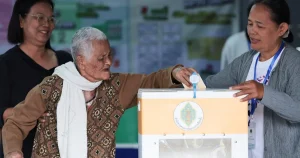
The Election Commission said approximately 53 million people are eligible to vote, with more than 2.2 million already having cast ballots during early voting that began on February 1.
Voter Fatigue and Uncertain Outcomes
Reporting from Bangkok, Al Jazeera correspondent Tony Cheng said many voters view the election with a sense of exhaustion rather than optimism.
“It’s only been three years since the last election, and there wasn’t supposed to be another one so soon,” he said. While the People’s Party is again expected to top the poll, Cheng noted that voters are increasingly concerned about whether electoral outcomes translate into real change.
“Thailand’s economy has been losing momentum while much of the region surges ahead,” he said. “There’s a widespread feeling that things need to move forward.”
Yet history suggests caution. “We’ve seen elected governments undone by coups and court rulings,” Cheng added. “People keep voting for reform, but the institutions have never fully allowed democracy to take hold.”
As ballots are counted, Thailand once again faces a familiar question: whether the will of voters will be reflected in who ultimately governs the country.