


As Rubel Chaklader guided his autorickshaw through Dhaka’s congested streets in late January, his voice carried fatigue rather than fury. The 50-year-old driver believes Bangladesh failed to seize a rare chance for transformation after the August 2024 uprising that forced longtime leader Sheikh Hasina to step down, ending 15 years in power marked by allegations of repression, political crackdowns, and widespread human rights abuses.
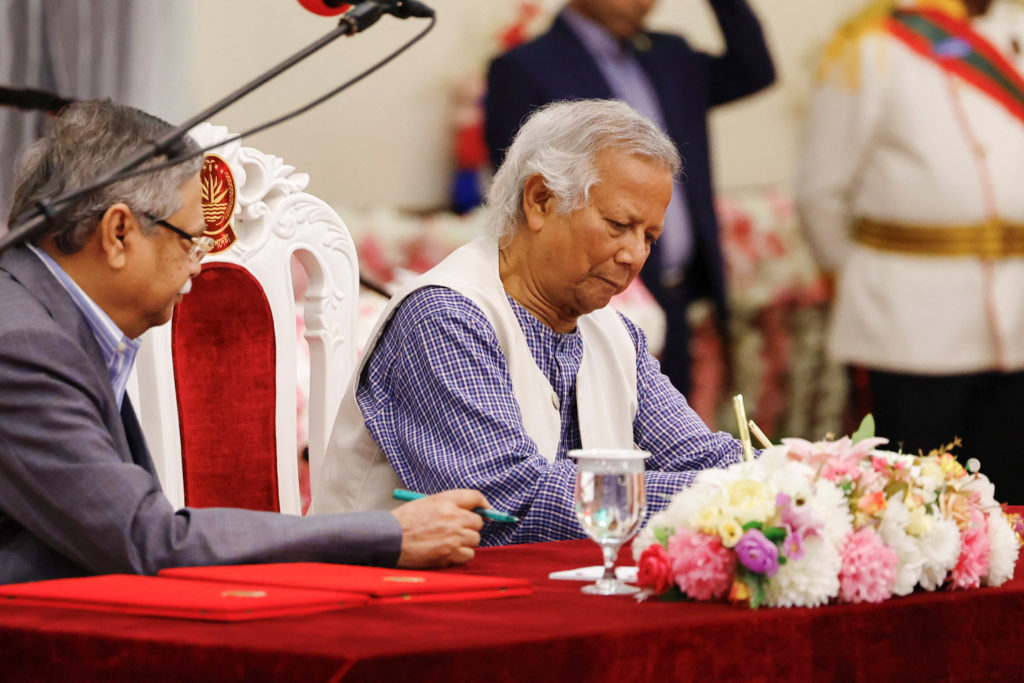
Within days of the student-led protests that compelled Hasina’s resignation, Muhammad Yunus, Bangladesh’s only Nobel Peace Prize winner, assumed leadership of an interim government tasked with steering a nation reeling from one of its deadliest political upheavals, which left more than 1,400 people dead.
A Narrow Mandate, High Expectations
At 85, Yunus framed his role carefully but ambitiously: restore credible elections and push reforms aimed at preventing a return to authoritarian rule by redistributing power among state institutions.
But Chaklader argues that entrenched interests within the bureaucracy and deeply polarised political parties undercut Yunus’s ability to deliver deeper change during his 18-month tenure.
“We missed our chance,” he said. “We didn’t allow Dr Yunus to work freely. Everyone came with unreasonable demands. People died last July for nothing.”
His remarks come as Yunus prepares to step aside after overseeing what many observers describe as Bangladesh’s first broadly free and fair election in over a decade, scheduled for February 12.
As the vote approaches, public opinion is sharply divided over how Yunus should be remembered.
Stabiliser or Missed Reformer?
The debate centres on one question: was Yunus the steady hand who prevented a fragile state from collapsing, or did he fall short of delivering the sweeping structural changes demanded by the 2024 movement?
For the student leaders who spearheaded the uprising, Yunus’s global reputation and moral authority were decisive at a moment when Bangladesh — a major garment exporter — needed international reassurance.
“At that point, we needed someone acceptable to everyone,” said Nahid Islam, a former protest leader who now heads the National Citizen Party (NCP), a new political platform created by activists from the uprising.
Others involved in the negotiations said Yunus was initially reluctant, describing himself as “not a political person”. But as violence escalated, he stepped in out of what analysts describe as a sense of responsibility to the country.
Reform Drive Under Scrutiny
Yunus presided over one of the most ambitious reform efforts ever undertaken by an interim government in Bangladesh. Without a sitting parliament, his administration relied on expert commissions to investigate institutional failures and document abuses under the previous government.
These initiatives included inquiries into the judiciary, police, electoral system, and enforced disappearances. Supporters hailed the process as long-overdue accountability; critics accused an unelected administration of overreach.
Among the most consequential steps was the formation of the Commission of Inquiry on Enforced Disappearances, which documented more than 1,500 verified cases linked primarily to security agencies. Yunus publicly acknowledged the existence of secret detention facilities known as Aynaghor, a move that marked a significant break from years of official denial.
Human rights advocates credited Yunus for cooperating with the United Nations, whose investigators confirmed that excessive force had been used by security forces during the 2024 uprising.
Still, some analysts argue that the reform agenda was constrained by institutional resistance and the limited authority of an interim government.
Justice, But Limits to Change
The judiciary, long accused of political compliance, appeared more assertive under Yunus. Courts ordered trials against former officials implicated in abuses, including cases linked to extrajudicial killings and disappearances.
Yet expectations for a broader overhaul of the bureaucracy and security sector went largely unmet.
“There was hope he would challenge the entrenched administrative culture,” said political analyst Dilara Choudhury. “But the resistance was structural, and his mandate was limited.”
A Referendum Gamble
In a move unprecedented in Bangladesh’s history, Yunus tied the February 12 election to a nationwide referendum on key reform proposals. The aim, his supporters say, is to secure public consent for changes that could dismantle systems enabling abuse of power.
If approved, the next parliament will decide whether to implement the reforms. If rejected, the agenda may quietly fade.
For many observers, this uncertainty defines Yunus’s legacy.
“He led at a moment when the country could have fallen apart,” said political analyst Mubashar Hasan. “What endures after he leaves will determine how history judges him.”
Divided Politics, Uncertain Future
Major political parties remain split. The Bangladesh Nationalist Party (BNP) acknowledges Yunus’s role in restoring stability but argues that some reforms should have been left to an elected government. Meanwhile, the NCP and its allies maintain that deeper reforms were necessary before elections.
Economic conditions remain fragile. While macro-level indicators stabilised, unemployment, stagnant wages, and weak investment continue to strain households.
Even so, many see the February 12 election itself as Yunus’s most tangible achievement.
‘A Country of the Blind’
For families of those killed during the uprising, Yunus’s legacy is inseparable from justice.
“We gave our children’s lives in exchange for accountability,” said Sanjida Khan Deepti, whose teenage son was killed during the protests. “How could one man complete so many tasks in such a short time?”
Back in Dhaka traffic, Chaklader remains sceptical. Despite planning to vote, he doubts the election will meaningfully change his life — or the country’s trajectory.
“In a country of the blind,” he said quietly, “even a mirror has no value.”