


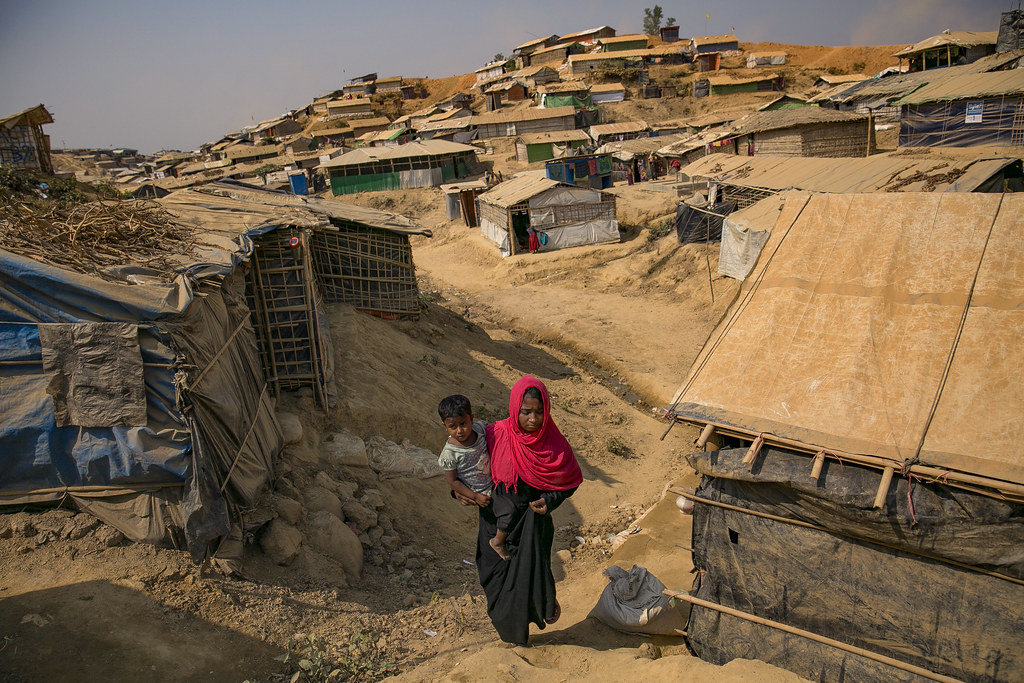
Inside the Balukhali Rohingya refugee camp in southeastern Bangladesh, 19-year-old Mahmudul Hasan spent a recent afternoon arranging floor mats inside his bamboo-and-tarpaulin shelter. Soon, dozens of young children filed in, greeting him respectfully in their Rakhine dialect. Though still a teenager, Hasan is their teacher.
While lessons in Burmese, English and mathematics were under way, a very different message echoed through the camp. A Bangladeshi government official rode through the narrow lanes on a motorcycle, announcing restrictions ahead of the country’s February 12 national elections.
From February 9 to February 13, refugees were told to shut their shops, remain inside the camp, and avoid all political activity. Any violation, the official warned, could result in severe penalties — including the loss of refugee registration cards and access to subsidised food rations.
For the more than one million Rohingya refugees living in camps around Cox’s Bazar, the announcement reinforced a long-standing reality: while Bangladesh prepares to choose its next government, they remain on the sidelines.
“I don’t have any expectations,” Hasan told Al Jazeera. “I just want to live with dignity and basic human rights. This life is not something I chose.”
Life in Limbo
The Rohingya fled Myanmar in 2017 after a brutal military crackdown that forced hundreds of thousands across the border. Bangladesh, under then Prime Minister Sheikh Hasina, offered them refuge when few other countries would.
Yet years later, refugees remain confined to fenced camps, with limited access to education, healthcare, employment and freedom of movement.
Hasan acknowledged that candidates from the two main political blocs — alliances led by the Bangladesh Nationalist Party (BNP) and Jamaat-e-Islami — have spoken about Rohingya issues during campaigning in Ukhia and Teknaf, where most camps are located. That, he said, offers a small measure of hope.
Gratitude Mixed With Frustration
Rohingya leaders say the community remains thankful to Bangladesh and its people, but frustration is growing.
Nay San Lwin, a Rohingya diaspora leader and co-chair of the Arakan Rohingya National Council, said Bangladesh’s policy of non-integration has kept refugees isolated.
“Barbed-wire fences, lack of formal education, and restrictions on livelihoods mean Rohingya remain on the margins,” he said. “The next government should improve education, healthcare and livelihoods while fostering better relations with host communities.”
But shrinking international aid has worsened conditions. Funding cuts have reduced already limited services in the camps.
“The humanitarian situation is deteriorating,” said Sayed Ullah, president of the United Council of the Rohingya. “Insecurity, reduced aid, lack of education and uncertainty about the future are pushing people to despair.”
Daily Struggles in the Camps
For older refugees like 64-year-old shopkeeper Hafez Ahmed, healthcare is a growing concern.
“We only get basic medicines,” he said. “If doctors find something serious, they tell us to go to private hospitals. We can’t afford that. And rations keep shrinking — it’s not enough.”
Younger refugees speak of lost dreams. Hasan described camp life as suffocating.
“Living here feels like prison,” he said. “I wanted to become a teacher who contributes to the world. Now I feel like someone without a future.”
Such despair has driven many Rohingya to attempt dangerous sea journeys in search of a better life.
In a joint statement, the UNHCR and the International Organization for Migration said more than 5,300 Rohingya attempted perilous maritime crossings in 2025 alone, with over 600 missing or dead.
Election Promises and Political Uncertainty
Bangladesh’s election follows major political upheaval. In August 2024, Hasina fled to India after a student-led uprising. She was later sentenced to death in absentia over a violent crackdown that killed more than 1,400 protesters.
Since then, Nobel laureate Muhammad Yunus has led an interim administration.
Both the BNP and Jamaat say resolving the Rohingya crisis is a priority.
“Safe and dignified repatriation is central to our policy,” said Israfil Khosru, a BNP leader, stressing that Rohingya citizenship rights in Myanmar must be guaranteed.
Jamaat officials said they are collecting policy proposals from citizens and the diaspora. “Repatriation with security and dignity is one of our top goals,” said assistant secretary Ahsanul Mahboob Zubair.
However, analysts say Rohingya issues are not a central focus of the election campaign.
“The next government will need strong regional and global engagement to sustain support for this community,” said Tanvir Habib, an international relations scholar at Dhaka University.
Tensions With Host Communities
Not all Bangladeshis view the Rohingya presence sympathetically. In Ukhia, local resident Mahabub Alam described refugees as a strain on jobs and security.
“They work for lower wages and affect our labour market,” he said, also blaming Rohingya for crime and trafficking — claims refugee leaders strongly contest.
Former Bangladeshi diplomat Shahidul Haque said public impatience is growing. “People want a solution. Law and order and national security are affected. Expectations on the next government are high.”
Waiting for a Way Home
Despite the uncertainty, most Rohingya see their stay in Bangladesh as temporary.
Back in the camp, Ahmed, the elderly shopkeeper, summed up a sentiment shared by many.
“I want to return to my homeland with rights,” he said quietly. “I want to die where I was born.”