


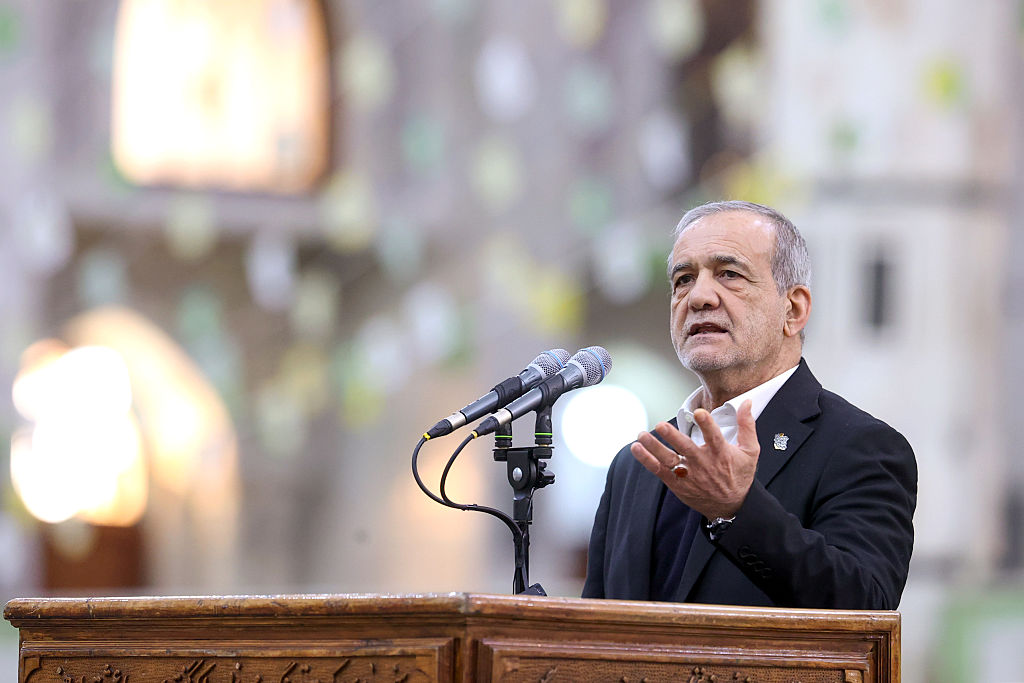
Iran president has said he has instructed senior diplomats to pursue talks with the United States, signalling a possible diplomatic opening as fears of a military confrontation appear to be receding.
President Masoud Pezeshkian said in a social media post on Tuesday that he had directed Iran’s foreign minister to seek negotiations with Washington under what he described as fair and balanced conditions.
“I have instructed my Minister of Foreign Affairs, provided that an appropriate environment exists — free from threats and unreasonable demands — to pursue fair and equitable negotiations, guided by dignity, prudence and expediency,” Pezeshkian wrote.
His remarks appear to confirm reports that Tehran is prepared to participate in talks being facilitated by Turkiye, as regional powers step up efforts to defuse tensions between Iran and the US.
Signs of De-escalation After Military Threats
The announcement follows weeks of heightened tension, during which the United States deployed warships to the region and President Donald Trump repeatedly warned Iran of possible military action.
However, comments from both sides over the weekend suggested that backchannel diplomacy was making progress. On Sunday, Trump said the US was “talking with Iran”, a statement later reinforced by Iranian officials.
On Monday, Tehran said it was reviewing several diplomatic initiatives proposed by regional mediators — including Qatar, Turkiye, Egypt and Oman — aimed at easing tensions with Washington. Iranian officials said they expected a framework for talks to emerge in the coming days.
Possible Talks in Istanbul
Later on Monday, media reports said discussions were being organised to take place in Istanbul on Friday. According to those reports, the talks would involve US Special Envoy Steve Witkoff and Iran’s Foreign Minister Abbas Araghchi.
Neither Tehran nor Washington has officially confirmed that such a meeting has been scheduled.
Iran’s Foreign Ministry spokesperson Esmaeil Baghaei said indirect negotiations were already under way, with regional countries acting as intermediaries in the exchange of messages.
“Several issues have been addressed,” Baghaei said. “We are examining and finalising the details of each stage of the diplomatic process, which we hope to conclude in the coming days.”
Regional Diplomacy Intensifies
Iran’s state news agency IRNA reported that Araghchi had spoken by phone with his counterparts in Saudi Arabia, Egypt and Turkiye to discuss the latest developments.
Meanwhile, Fars News Agency quoted an unnamed source as saying Pezeshkian had ordered the resumption of negotiations over Iran’s nuclear programme. The report did not give a date and has not been independently verified.
Iranian outlet Tasnim News Agency also reported that Araghchi was expected to meet Witkoff as part of the diplomatic push.
A White House official said Witkoff was due to arrive in Israel on Tuesday for talks with Israeli Prime Minister Benjamin Netanyahu.
Pressure for a Nuclear Agreement
The diplomatic movement comes as Iran has been preparing for the possibility of a US strike, with American aircraft carriers and fighter jets positioned in the Indian Ocean within reach of the region.
Trump issued threats following mass protests in Iran earlier this year, when economic hardship and currency collapse — worsened by sanctions — sparked demonstrations that escalated into a broader challenge to the government.
In recent weeks, however, Washington’s focus has shifted toward securing a nuclear deal. The US and European Union have long accused Iran of seeking nuclear weapons, a claim Tehran rejects, insisting its nuclear programme is strictly civilian.
Key Conditions Still Divide Sides
Despite Tehran’s stated willingness to reopen talks, major obstacles remain. Iranian sources told Reuters that the US has demanded Iran halt uranium enrichment, limit its missile programme and end support for allied armed groups in the region.
While Iran has previously shown flexibility on its nuclear activities, it has consistently treated its missile capabilities and regional alliances as non-negotiable.
Analysts say it remains unclear whether Iran will adjust its position, even as the country seeks sanctions relief to stabilise its economy and prevent renewed unrest.
Earlier negotiations launched in Oman in June collapsed after Israel carried out strikes on Iran, followed by US attacks on Iranian nuclear facilities.
On Sunday, Trump said Iran was “seriously talking” with the US, but added that Washington still had “very big, powerful ships heading in that direction”.
Iran’s Supreme Leader Ali Khamenei also struck a defiant tone, warning that any attack on Iran would lead to a “regional war”.