


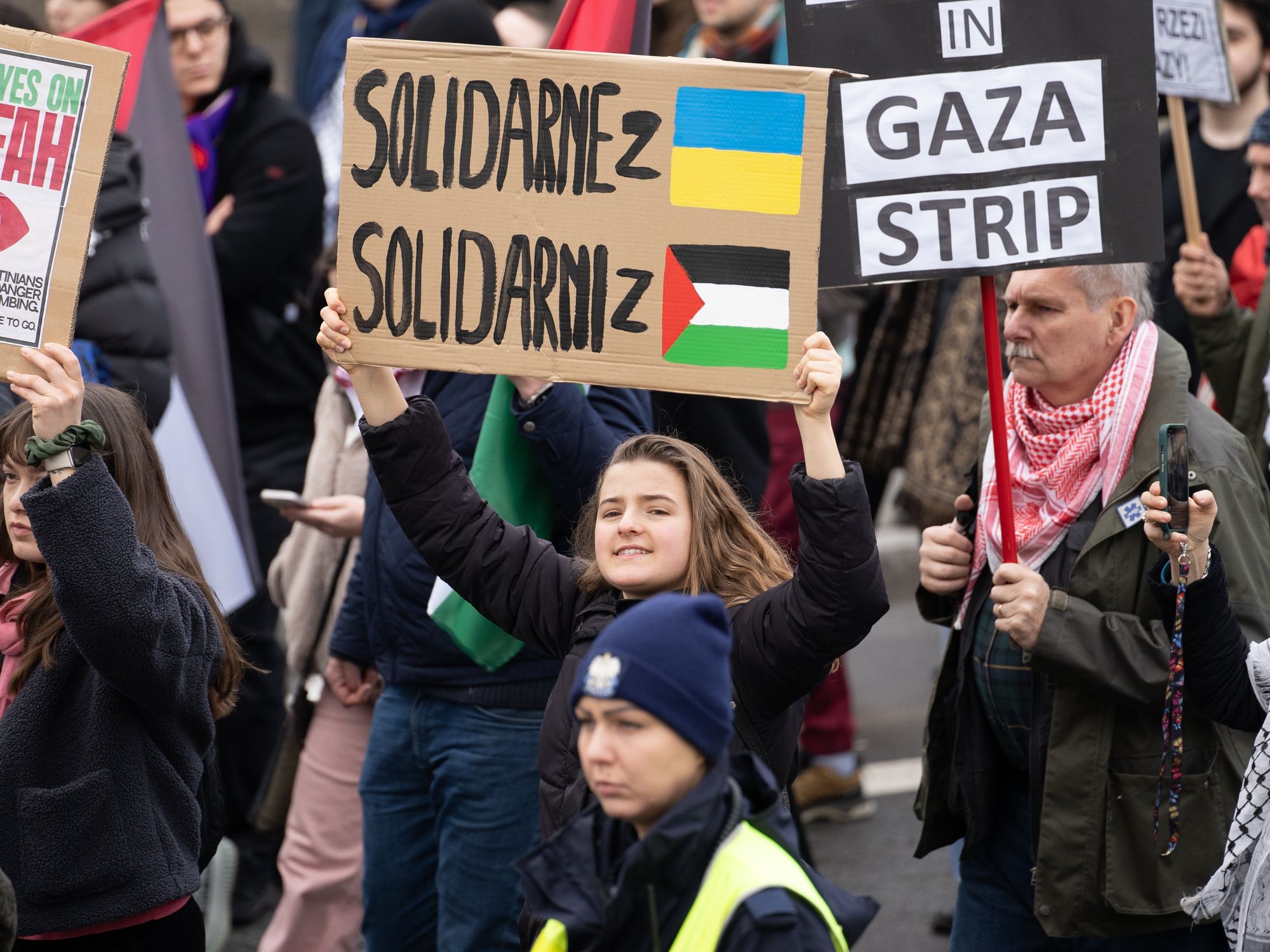
When Israel launched its war on Gaza in October 2023, Ukraine leadership moved swiftly to express solidarity with Israel. President Volodymyr Zelenskyy publicly backed Israel, while First Lady Olena Zelenska said Ukrainians understood and “shared the pain” of the Israeli people.
Across Kyiv, billboards illuminated the capital with Israeli flags, reflecting a stance widely shared by Ukrainian society and echoed by many Western governments at the time.
For people with close ties to both Ukraine and Palestine, those early displays were difficult to witness.
‘Travelling as a Palestinian closes doors’
Hashem, a Gaza-born medical professional who became a Ukrainian citizen after nearly a decade in the country, said the contrast in how Palestinians and Ukrainians are treated internationally has long been impossible to ignore.
“Travelling as a Ukrainian opens doors; travelling as a Palestinian closes them,” he said, pointing to stark differences in visa access, freedom of movement and public sympathy attached to each passport.
“This isn’t a competition of suffering,” Hashem added. “It’s about principle. If human rights are universal, they shouldn’t depend on nationality.” He asked that his surname be withheld.
Reconsidering Israel
As Israel’s bombardment of Gaza continued and developed into what many now describe as a genocide against Palestinians, some Ukrainians say public opinion has slowly shifted.
Yuliia Kishchuk, a Ukrainian academic who joined more than 300 scholars, activists and artists in signing an open letter expressing solidarity with Palestinians, said images of starvation in Gaza forced many to reassess their views.
She noted that some Ukrainians drew parallels with the Holodomor, the Soviet-era famine Kyiv recognises as a deliberate act of genocide.
Kishchuk said Israeli strikes beyond Gaza, including in Syria, also challenged the narrative that Israel was acting purely in self-defence.
In Kyiv, small pro-Palestinian demonstrations began to emerge, while prominent journalists and podcasters started openly discussing Palestinian suffering. However, Kishchuk said recent Russian attacks on Ukraine’s energy infrastructure — leaving millions without heat, electricity or water during winter — have temporarily slowed this growing activism.
Changing Perceptions of the United States
Ukrainian attitudes toward the United States have also evolved. President Donald Trump’s approach to the Russia-Ukraine war has left many Ukrainians disillusioned, Kishchuk said.
Washington is increasingly viewed not only as an ally, but as a power willing to treat Ukraine as a source of strategic resources, while adopting a softer tone toward Russian President Vladimir Putin.
She said a recent minerals agreement granting the US access to Ukraine’s rare earth resources reinforced the perception of Ukraine as “a resource base” — a dynamic she said connects Ukraine’s experience with that of Palestine and countries in the Global South historically shaped by imperial interests.
Kyiv’s Official Shift
Ukraine’s official position on Palestine has also evolved. Speaking at the Shangri-La Dialogue in 2024, Zelenskyy said Ukraine recognised both Israel and Palestine as states and would push for an end to civilian suffering.
In July 2024, Kyiv sent 1,000 tonnes of wheat flour to Palestinian territories through its “Grain from Ukraine” humanitarian initiative. Ukraine’s foreign ministry later condemned Israel’s September 2025 attack on Qatar, calling it a serious violation of international law.
‘War has the same face everywhere’
For Aaisha Aroggi, a 25-year-old student from Gaza City, the shifting attitudes feel deeply personal. Displaced ten times in the early months of Israel’s war, she eventually reached Egypt via Rafah and later moved to Ukraine, where she received residency because her brother lives in Kyiv.
“At first, Kyiv felt safe compared to Gaza,” she said. “But now, with constant Russian attacks, it feels like moving from one place of destruction to another.”
“War has the same face everywhere,” Aroggi added.
She said that while many Europeans initially struggled to understand the Palestinian experience, Palestinian voices and platforms have since spread widely across the continent.
“At my university, students ask about Gaza and show real support,” she said. “They understand what has happened.”
Double Standards Persist
Despite growing awareness, Hashem said double standards remain — though he does not blame ordinary Ukrainians.
“In Ukraine, reactions vary when I talk about Palestine,” he said. “Some people listen and try to understand. Others resist comparisons because they’ve been told for years the situations aren’t comparable.”
Still, he believes moments of political and social change can open space for deeper empathy.
“Losing support makes people reflect,” he said. “Solidarity based on principles — not politics — is the only kind that truly lasts.”