


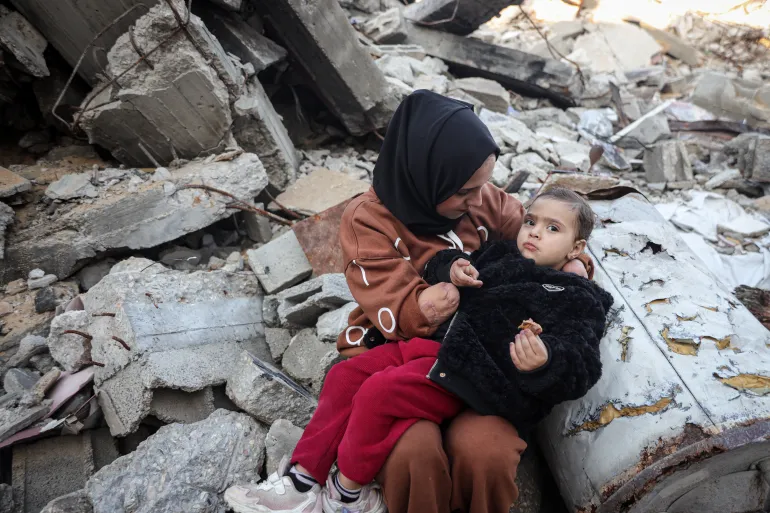
From her family’s tent in an-Nazla, Jabalia, in northern Gaza, Nebal al-Hessi follows news updates on her phone about the limited reopening of the Rafah border crossing — a development that could determine whether she ever receives proper medical care.
Using what remains of her injured forearms, the 25-year-old mother scrolls carefully, hoping for confirmation that she will be allowed to leave Gaza for treatment.
Nebal lost both hands in an Israeli artillery strike on October 7, 2024, when the home where she was sheltering with her husband and infant daughter was hit in the Bureij refugee camp in central Gaza.
More than a year later, she is among thousands of wounded Palestinians whose survival and recovery depend on access to medical treatment outside the besieged enclave.
“Every day I think maybe tomorrow I will travel,” Nebal told Al Jazeera quietly. “But I don’t know if that day will ever come.”
A Life Changed in Seconds
Nebal recalls sitting on her bed with her baby daughter Rita in her arms, trying to connect to the internet to contact family members in northern Gaza.
“I was holding my daughter and trying to get a signal,” she said. “Suddenly the shell hit. There was dust everywhere. After that, I don’t remember anything.”
Shrapnel from the blast severed both of her arms. She was rushed to hospital with catastrophic injuries, including full amputations up to her elbows, internal bleeding and a leg wound. She underwent two abdominal surgeries and remained hospitalised for about 40 days.
After being discharged, Nebal’s struggle continued in overcrowded displacement tents, without access to rehabilitation or specialised long-term care.
‘My Life Is Completely Paralysed’
An English translation graduate and mother of a two-year-old, Nebal now depends almost entirely on her family for daily survival.
“I can’t eat or drink alone. I can’t get dressed by myself,” she said. “My mother, my sister and my sister-in-law help me with everything — even going to the bathroom.”
Motherhood, she said, has become a source of constant pain.
“My daughter wants me to hold her, feed her, change her clothes like other mothers do,” Nebal said. “She asks me, and I can’t. My life is completely paralysed.”
Doctors have told Nebal she urgently needs to travel abroad to continue treatment and receive advanced prosthetic limbs — not for cosmetic reasons, but to regain independence.
“They told me I need a country or an institution to take responsibility for my case,” she said, “so I can slowly return to a normal life.”
Waiting Lists and Unclear Criteria
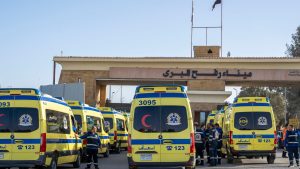
As Palestinian authorities announced arrangements to open the Rafah crossing for limited medical travel, Nebal said she has been living in a state of anxious anticipation.
According to Gaza’s Ministry of Health, thousands of wounded and chronically ill people require specialised treatment unavailable inside the Strip. However, travel depends on medical lists, approvals and coordination, with no publicly announced timetable or clear prioritisation system.
Nebal said medical organisations contacted her repeatedly over the past months, telling her to prepare for travel.
“They gave me hope,” she said. “But this time, no one has contacted me.”
She fears the pilot reopening could pass her by, leaving her trapped once again.
“I am dying a little every day,” she said. “Not figuratively. My daughter is growing up in front of me, and I am helpless.”
A Teenager’s Future on Hold
Sixteen-year-old Nada Arhouma is also waiting for Rafah to open in a meaningful way. Displaced from Jabalia refugee camp, Nada was struck in the face by shrapnel while sheltering in a tent in Sheikh Radwan, Gaza City.
The injury destroyed one of her eyes and caused severe fractures and tissue damage to her face.
Her father, Abdul Rahman Arhouma, said her condition deteriorated despite months of treatment in Gaza.
“She was in intensive care at al-Shifa Hospital, then transferred to Nasser Hospital,” he said. “Doctors tried three times to reconstruct her eye using tissue from her hand and face, but all the surgeries failed.”
Nada now experiences daily bleeding, infection and worsening disfigurement. She struggles to walk alone due to dizziness and balance problems, and her remaining eye has also been affected.
“I can’t even go to the bathroom without help,” Nada said softly. “My sisters have to support me.”
She has an official medical referral and urgently needs reconstructive surgery and a prosthetic eye abroad — treatment that cannot be provided inside Gaza.
“Every week they say the crossing will open next week,” she said. “Honestly, I’m not optimistic anymore.”
‘We Can’t Plan Our Lives’
Nada’s father described the pilot reopening as confusing and deeply frustrating.
“All the information comes from Israeli sources,” he said. “Rafah looks like a gate for prisoners, not for patients.”
He added: “We can’t plan whether to stay or leave. Even the Ministry of Health doesn’t know what will happen.”
Sunday marked the first day of Israel’s pilot reopening of the Rafah crossing, but details remain scarce — including how many patients will be allowed to travel and under what conditions.
The World Health Organization has repeatedly warned that Gaza’s healthcare system is on the verge of collapse, stressing that delays in medical evacuations could cost lives.
Israel has said only individuals whose names are approved in advance will be permitted to cross, without clarifying daily quotas or selection criteria.
Cancer Patients Left Behind
Raed Hamad, a 52-year-old father of four, is another patient desperate to leave Gaza. Diagnosed with kidney cancer before the war, he underwent surgery to remove the affected kidney. When fighting escalated in October 2023, his treatment plan was abruptly halted.
Now living in the ruins of his destroyed home in Khan Younis, Hamad said continuing cancer care has become nearly impossible.
“Medicines are unavailable. Treatment protocols don’t exist anymore,” he said. “The war, the food shortages, the stress — everything has damaged my health.”
His weight has dropped from 92kg to 65kg due to illness, malnutrition and lack of treatment.
“Every time I go to the hospital, my medication isn’t there,” he said. “My immunity is weak, and each day brings new suffering.”
Hamad said he urgently needs scans and specialised drugs to continue treatment — care that remains out of reach as long as Gaza’s borders stay largely closed.