


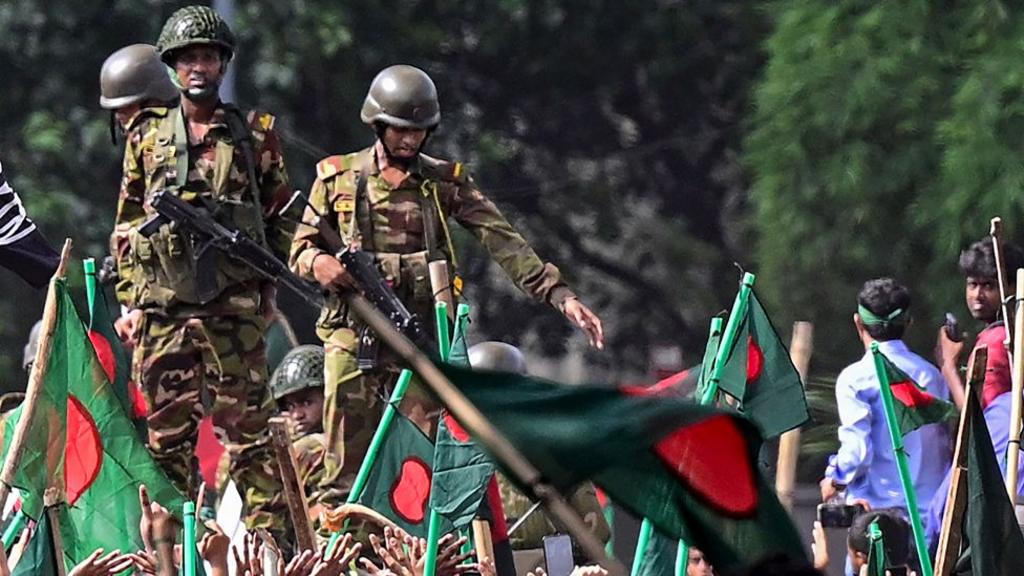
In Bangladesh political conversations, one word has increasingly come to symbolise the deeper question of power in the country: Kochukhet.
The Dhaka neighbourhood that hosts major military installations has become shorthand for the influence of the cantonment over civilian affairs — particularly politics — as Bangladesh prepares for national elections on February 12.
The vote will be the country’s first since the 2024 uprising that ended the long rule of former prime minister Sheikh Hasina and led to the formation of an interim government headed by Nobel laureate Muhammad Yunus.
Army Central to Election Environment, Not the Ballot
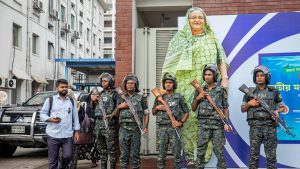
While the military is not contesting political office, it has emerged as a central force shaping the election atmosphere. With police capacity weakened following last year’s unrest, the army has become the most visible guarantor of public order.
For nearly 18 months, soldiers have been deployed nationwide under special orders granting them magisterial powers. During the election period, officials expect as many as 100,000 troops to be mobilised, with proposed rule changes formally listing the armed forces as law-enforcement agencies during polling.
Bangladesh’s history — marked by coups, counter-coups and years of military rule — continues to shape public perceptions. Analysts say the army is unlikely to stage an overt takeover, but remains a decisive power centre embedded across the state through its security role, intelligence reach and institutional presence.
A Stabilising Force, According to Analysts
Thomas Kean, senior consultant on Bangladesh and Myanmar at the International Crisis Group, said the military has been “backstopping the interim government” both politically and operationally amid weakened policing.
“There are different factions within the army,” Kean told Al Jazeera, “but overall, the institution wants the election to take place as smoothly as possible so it can return to the barracks.”
Kean argued that if the military leadership had wanted to seize power, it could have done so when the political order collapsed on August 5, 2024 — the day Hasina fled to India — but chose not to, partly due to lessons learned from past interventions.
Institutional Interests and Quiet Influence
Asif Shahan, a political analyst and professor at University of Dhaka, said a direct takeover would have endangered key military interests, including Bangladesh’s role in United Nations peacekeeping missions, which bring both financial returns and international prestige.
However, Shahan described the army as “an important political actor” whose influence today lies less in direct intervention and more in its institutional weight — through intelligence agencies, infrastructure involvement and commercial interests.
He said the military’s extensive footprint across state projects and business ventures has created concerns that informal pressure could be exerted on future civilian governments to preserve existing privileges.
Low Risk of Direct Intervention
Despite concerns, analysts broadly agree the likelihood of the military seeking overt control remains low unless a major law-and-order breakdown triggers public demand for intervention.
Rajib Hossain, a former army officer and author of Commando, said the institution has strong incentives to remain neutral.
“There is a clear understanding that if the army fails to act impartially, it risks losing the public trust it still retains,” Hossain said.
Mustafa Kamal Rusho, a retired brigadier general at the Osmani Centre for Peace and Security Studies, echoed that view, saying the military does not appear to have “any clear intent” to influence politics — though it remains a critical power base.
The 2024 Uprising and a Defining Moment
The military’s influence was most visible during the 2024 uprising, when it declined to fully enforce curfew orders and refused to fire on civilians, a decision many observers believe prevented wider bloodshed.
The army facilitated Hasina’s departure to India and announced the formation of an interim government, a move widely seen as decisive in shaping the transition.
In an Al Jazeera documentary, army chief Waker-uz-Zaman said his forces would not turn their weapons on civilians, stressing that political involvement was “not our cup of tea”.
A History That Still Looms Large
Bangladesh’s past tells a different story. Following the 1975 assassination of founding leader Sheikh Mujibur Rahman, the country endured years of military rule that reshaped its political landscape.
The Bangladesh Nationalist Party was founded by military ruler Ziaur Rahman, while another army chief, Hussain Muhammad Ershad, seized power in 1982 and ruled much of the decade.
Although civilian rule was restored in 1991, the military continued to exert indirect influence, including backing a caretaker government during the political crisis of 2007.
Blurred Lines in the Post-Hasina Era
Recent comments by General Zaman backing the interim government and proposing election timelines drew criticism for crossing institutional boundaries, highlighting lingering tensions over civil-military roles.
Analysts say the uncertainty following Hasina’s fall — including questions over accountability, reforms and the military’s future position — has contributed to such public interventions.
The Legacy of the Security State
Human rights groups argue that under Hasina’s 15-year rule, security institutions were routinely used for political repression. A national inquiry has verified more than 1,500 enforced disappearances, many linked to political affiliation.
Several senior military officers now face civilian trials over alleged abuses — a rare and sensitive development in Bangladesh’s history that has strained relations between the interim government and the armed forces.
Some former officers see the prosecutions as damaging; others argue they offer a chance for institutional redemption and renewed professionalism.
A Test for Democracy
Kean said the coming election will test whether Bangladesh can prevent its security apparatus from once again becoming entangled in partisan politics.
“The military will remain powerful,” he said. “The challenge is whether it can support civilian rule without dominating it.”
Ultimately, analysts say, responsibility does not rest with the army alone. Civilian leaders must also resist the temptation to politicise security forces — a lesson Bangladesh has learned repeatedly, and at great cost.