


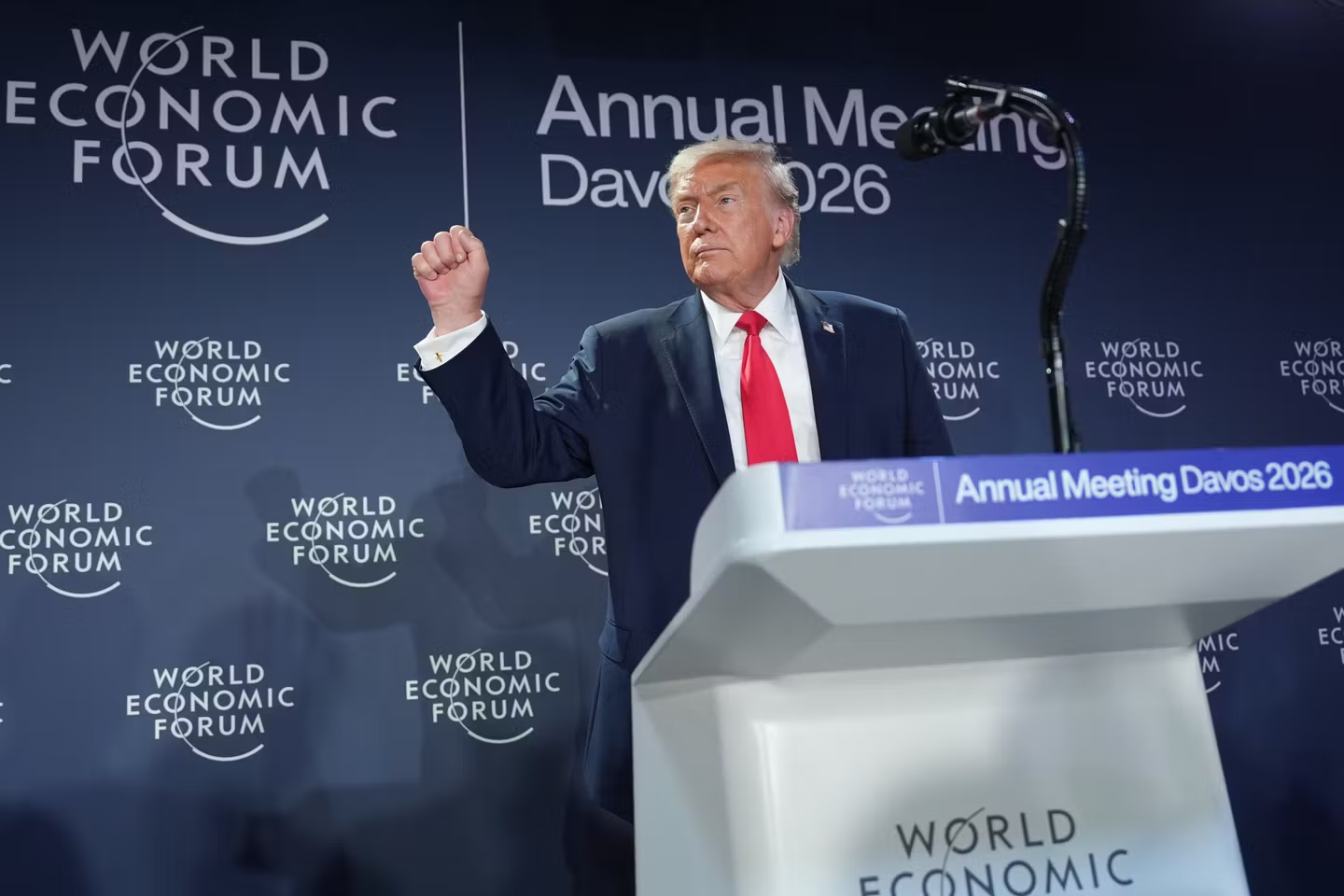
U.S. President Donald Trump has withdrawn his threat to impose tariffs on European countries opposing his bid to take control of Greenland and said he would not use military force to seize the territory, marking a sharp reversal that eases one of the most serious transatlantic disputes in decades.
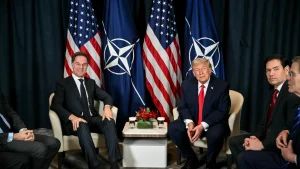
Speaking on Wednesday, Trump said he would no longer pursue the planned trade measures after reaching what he described as a “framework” with Mark Rutte, NATO’s secretary-general, covering Greenland and broader Arctic security.
Framework Deal Reached in Davos
Trump announced the shift following talks with Rutte on the sidelines of the World Economic Forum in Davos. In a post on Truth Social, Trump said the proposed framework would benefit both the United States and its allies.
“If finalized, this solution will be a great one for the United States of America and for all NATO nations,” Trump wrote, without providing further details.
He said the discussions also touched on his proposed “Golden Dome” missile defence system, as well as security and resource considerations linked to Greenland.
NATO Emphasises Arctic Security, Not Sovereignty
In brief remarks to reporters, Trump said the framework addressed “security and minerals and everything else.” Rutte, speaking separately to Fox News, declined to clarify whether the talks involved any transfer of sovereignty.
“We discussed how to implement the president’s vision on protecting Greenland — and not only Greenland, but the entire Arctic,” Rutte said.
Asked whether Denmark would retain control over Greenland, Rutte said the issue “did not come up.”
A NATO spokesperson later told Al Jazeera that Rutte had not proposed any compromise on sovereignty and that the discussions focused on collective efforts to strengthen Arctic security.
Tariff Threats Dropped After Weeks of Escalation
Trump had spent weeks warning that he would impose tariffs on Denmark and several other European countries unless they agreed to a deal allowing the United States to acquire Greenland, a semi-autonomous territory of Denmark.
The proposed measures included a 10 percent tariff starting in February, rising to 25 percent by June, moves that threatened to disrupt roughly $1.7 trillion in transatlantic trade and raised questions about the future of NATO.
Denmark repeatedly rejected Trump’s demands, insisting Greenland was not for sale and warning that any attempt to seize it by force would effectively end the NATO alliance.
Trump Rules Out Military Action
Trump’s reversal came hours after he told world leaders in Davos that he would not use force to annex Greenland, even as he maintained that the island was critical to U.S. and international security.
“I don’t have to use force. I don’t want to use force. I won’t use force,” Trump said, adding that he was seeking immediate negotiations on Greenland’s future.
He argued that the vast Arctic territory, rich in minerals, was strategically vital in light of growing Russian and Chinese activity in the region.
European Leaders Welcome De-Escalation
Danish Foreign Minister Lars Lokke Rasmussen welcomed Trump’s decision, saying it eased tensions after weeks of uncertainty.
“The day is ending on a better note than it began,” Rasmussen said, while stressing that Danish sovereignty over Greenland remained a “red line.”
Dutch Prime Minister Dick Schoof and Swedish Foreign Minister Maria Malmer Stenergard also praised the move, calling it a step toward de-escalation and renewed cooperation within NATO.
Stenergard said Trump’s demands had drawn “well-earned criticism” and suggested that coordinated pressure from allies had helped shape the outcome.