


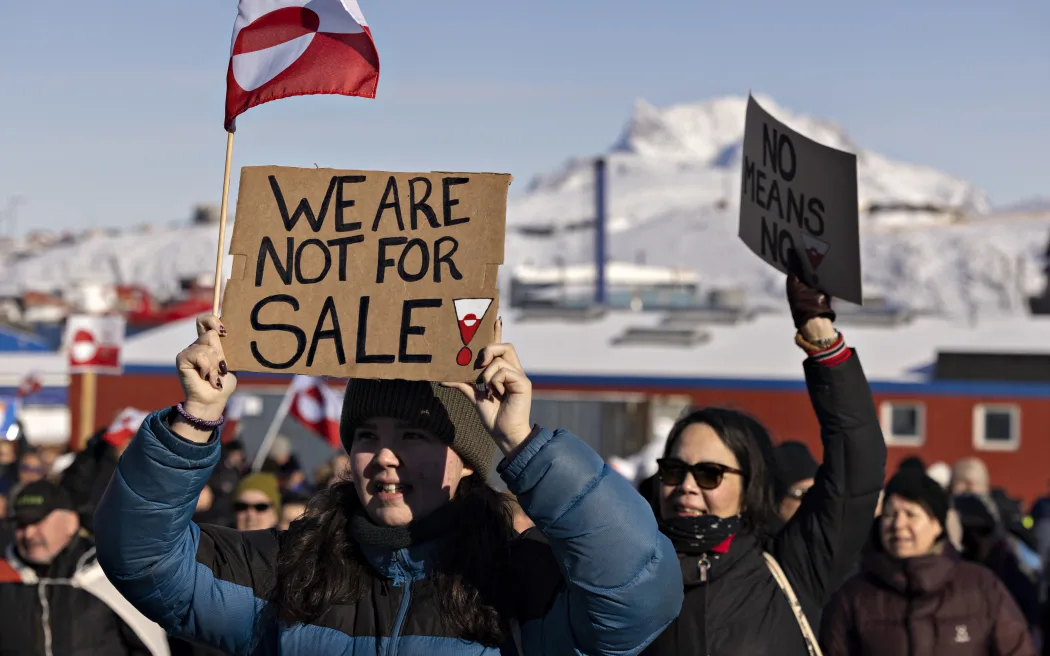
Inside a small office at the Danish parliament, journalists are ushered out one by one to make space for the next interview. For Aaja Chemnitz, one of Greenland two representatives in Copenhagen, the surge of international media attention has become relentless.
The reason is a rapidly escalating diplomatic crisis between Denmark and its NATO ally, the United States, following renewed statements by Donald Trump expressing interest in acquiring Greenland.
“Greenland is not for sale – and it never will be,” said Chemnitz, a member of the Inuit Ataqatigiit (IA) party. She stressed that Greenland is defined not by land or resources but by its people, language and culture. “Becoming American would fundamentally change who we are, and that is not something most Greenlanders want.”
Anxiety Grows Among Greenland’s Population
Greenland’s other MP, Aki-Matilda Hoegh-Dam of the Naleraq party, said the situation has created widespread unease among the island’s roughly 56,000 residents.
“For many Greenlanders, this has been an extremely turbulent period,” she said. “We have lived largely removed from great-power politics for centuries. Now, suddenly, we feel cornered – and that is deeply unsettling.”
As global scrutiny intensifies, Greenland’s elected officials are dividing their time between Nuuk and Copenhagen, trying to reassure citizens while navigating an increasingly uncertain diplomatic landscape.
“All political parties in Greenland agree on one thing,” Hoegh-Dam added. “We do not want to be Americans, and we do not want to be Danes. We want to be Greenlanders. We already experienced colonisation once. We do not want it again.”
A Deepening Foreign Policy Crisis
Since December, Trump has repeatedly revived the idea of U.S. ownership of Greenland – a proposal he first floated in 2019 during his previous term. At the time, Denmark’s prime minister dismissed the idea as unrealistic, prompting Trump to cancel a state visit.
This time, the stakes appear higher. The Trump administration has indicated that military force cannot be ruled out, rattling officials in both Nuuk and Copenhagen.
Although Greenland governs its own domestic affairs, Denmark still controls defence and foreign policy, placing the crisis squarely at the heart of the Danish state.
“This is the most serious foreign policy crisis Denmark has faced since World War Two,” said Hans Engell, a political commentator and former defence minister. “Even during the Cold War, it is hard to recall a situation this severe.”
Security, Resources and Strategic Ambitions
Trump has argued that Greenland is vital to U.S. national security. Geographically part of North America but historically tied to Europe, Greenland was colonised by Denmark around 300 years ago and gained self-rule in 2009. Despite that autonomy, it remains financially and militarily dependent on Copenhagen.
Greenland’s vast untapped resources – including rare earth minerals and potential oil reserves beneath its ice – have fueled speculation that economic interests are driving Washington’s renewed focus.
Others believe Trump is motivated by legacy. Acquiring Greenland would make him the U.S. president responsible for the largest territorial expansion in modern history. In a recent interview, he said outright ownership mattered more than indirect control.
Fear and Uncertainty on the Ground
For many Greenlanders, the rhetoric has crossed from political posturing into personal anxiety.
“Some people dismiss the threat, but others are genuinely losing sleep,” Hoegh-Dam said. “The problem is that Trump does not operate within the traditional rules. This feels like a break from the world order we were used to – and Greenland must now live with that reality.”
Trump has said he would prefer a negotiated “real-estate deal,” noting that the United States has attempted to buy Greenland before. In 1868 and again in 1946, U.S. administrations explored purchases, but Denmark rejected both efforts.
Any modern attempt would be far more complex, requiring Greenlandic consent. Denmark cannot simply sell the territory.
“I would rather do this the easy way,” Trump said last week. “But if not, we’ll do it the hard way.”
That remark has heightened fears, according to Masaana Egede, editor-in-chief of Sermitsiaq, Greenland’s largest news outlet. “It is deeply disturbing to face this kind of pressure – especially when it comes directly from the U.S. president.”
Diplomatic Talks Seen as Crucial
Last week, Denmark’s foreign relations committee held an emergency meeting under tight security, with phones left outside amid concerns about foreign surveillance.
Following the meeting, Denmark and Greenland jointly requested talks with Marco Rubio. The meeting, scheduled for this week, is viewed as potentially decisive.
“This discussion could shape Greenland’s future,” Hoegh-Dam said. “We need clarity on what the United States actually wants.”
Despite the pressure, Greenland’s leaders say public resolve remains strong.
“Greenlanders are proud and steady,” Chemnitz said. “We believe in our people and our nation. That belief will endure, regardless of who tries to claim us.”
As another reporter enters her office and the door closes once more, Greenland’s uncertain place in a rapidly shifting world order remains at the centre of global attention.