


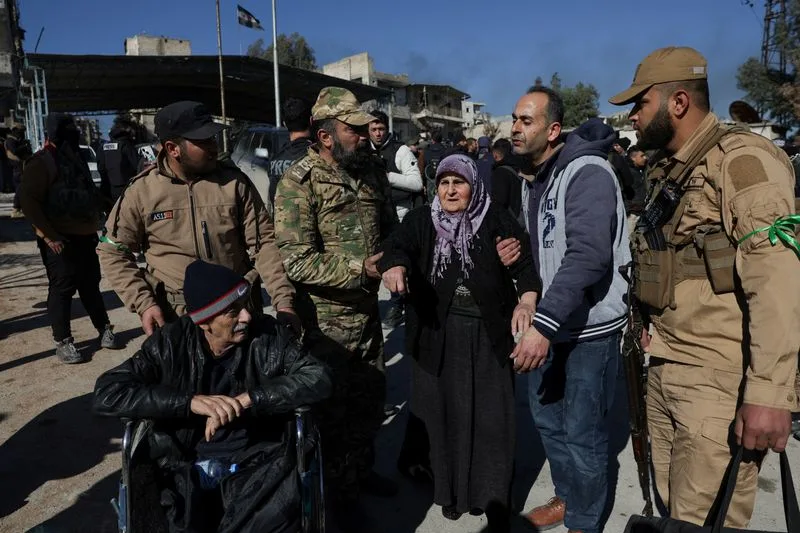
The final fighters from the Kurdish-led Syrian Democratic Forces (SDF) have withdrawn from the Syrian city of Aleppo, officials said, marking the end of days of violent clashes after a ceasefire agreement enabled evacuations.
Aleppo Governor Azzam al-Gharib told Al Jazeera early on Sunday that the city was now “free of SDF fighters,” following an overnight operation in which government forces coordinated their departure by bus.
SDF commander Mazloum Abdi, also known as Mazloum Kobani, said the group reached a ceasefire understanding through international mediation that allowed for the safe evacuation of civilians and combatants.
“We reached an agreement that ensures a ceasefire and the evacuation of the dead, the wounded, stranded civilians and fighters from the Ashrafieh and Sheikh Maqsoud neighbourhoods to northern and eastern Syria,” Abdi said in a post on X.
He urged mediators to uphold their commitments, calling for an end to violations and for displaced residents to be allowed to return safely to their homes.
Clashes and displacement
The withdrawal followed the Syrian army’s takeover of Sheikh Maqsoud, a predominantly Kurdish neighbourhood, after negotiations to integrate the SDF into the national armed forces collapsed.
At least 30 people were killed during the fighting, while more than 150,000 residents were forced to flee their homes, according to local officials.
Reporting from Damascus, Al Jazeera correspondent Ayman Oghanna said calm had largely returned to Aleppo, adding that the United States played a central role in brokering the agreement.
“The US is uniquely positioned because it maintains strong ties with both the SDF and the Syrian government,” Oghanna said, noting Washington’s long-standing cooperation with the Kurdish-led force in the fight against ISIL.
Broader political backdrop
Following the fall of former Syrian President Bashar al-Assad in 2024, the United States also established close relations with rebel commander turned interim leader Ahmed al-Sharaa. Sharaa later met US President Donald Trump at the White House and formally aligned Syria with the US-led coalition against ISIL.
The violence in Aleppo began on Tuesday in the Kurdish-majority districts of Sheikh Maqsoud, Ashrafieh and Bani Zaid, amid rising tensions over the failure to implement a March 2025 agreement that aimed to reintegrate the SDF into state institutions.
The deadline for that agreement expired at the end of last year, and the SDF refused to withdraw from areas it has controlled since the early stages of the Syrian conflict, which began in 2011.
Unresolved tensions
Although active fighting in Aleppo has ended, Oghanna warned that the underlying issues remain unresolved.
“The core fault line is still there,” he said. “The biggest challenge to Syria’s unity is whether the SDF will fully integrate under Damascus’s authority.”
The SDF is estimated to have between 50,000 and 90,000 fighters and controls nearly a quarter of Syria’s territory, primarily in the northeast.
Analysts say the Aleppo clashes have made prospects for integration even more uncertain, with key disagreements persisting over control, governance and autonomy in the region.
“The SDF does not want to relinquish control of northeastern Syria,” Oghanna said, adding that maintaining a degree of self-rule remains a central demand for the Kurdish-led force.
As Syria seeks stability after years of conflict, the question of how—or whether—the SDF can be incorporated into the state remains one of the country’s most pressing and unresolved challenges.