


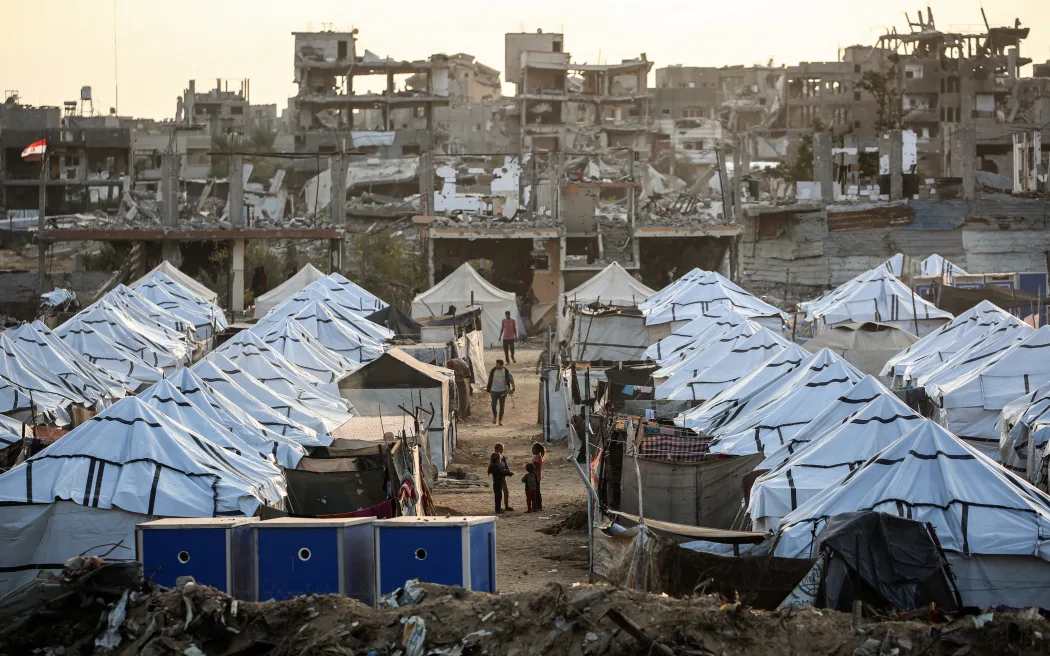
Severe winter conditions continued across Gaza this weekend, with heavy rainfall and unusually low temperatures worsening the already fragile living situation for thousands of displaced families. Local emergency responders confirmed new casualties after weakened structures gave way during the storm.
Gaza’s civil defense agency reported that two people died on Sunday, including a seven-year-old child, after a wall collapsed at a damaged residential site. The incident occurred as many families sought temporary refuge in unstable buildings that had already been impacted by months of conflict.
Rising Threat of Shelter Failures
The Government Media Office (GMO) in Gaza, which manages public communications for the interim local administration, stated that at least 49 buildings have collapsed since winter began, and 20 people have died in similar incidents over recent weeks. Aid organizations emphasized that the combination of storm pressure and deteriorating infrastructure has created new hazards, particularly for those without safe indoor shelter.
Families living in tents also faced destructive winds, which repeatedly damaged makeshift shelters. A resident of the Deir al-Balah refugee area, Eyad Abu Jdeyan, described how a tree had fallen onto his tent for the second time during the storm, destroying his family’s temporary cover.
“We feel invisible to the world. Who is protecting us now?” he said in a public statement shared through international media.
In the southern region of Khan Younis and Rafah Governorate, tents were flooded overnight, leaving standing water inside many shelters by morning. Civil defense spokesperson Ahmed Radwan noted that the environment has become nearly unlivable, even for animals, yet families remain with few relocation options.
“People are living in these areas because there is no alternative. Many were pushed to return toward damaged homes simply to find cover from the weather,” Radwan explained.
Aid Agencies Call for Expanded Support
The United Nations Relief and Works Agency (UNRWA) reiterated concerns over limited humanitarian access into Gaza. Commissioner-General Philippe Lazzarini said the organization stands ready to scale up emergency operations if aid deliveries can increase to match the growing need.
“Winter conditions are adding another layer of suffering. Families are surviving in temporary tents and unsafe surroundings,” Lazzarini said in a formal post published on social platform X.
Diplomatic Talks Continue in Florida
The winter emergency coincides with renewed political discussions in the United States. Israeli Prime Minister Benjamin Netanyahu is expected to meet President Donald Trump at Mar-a-Lago this week, as part of ongoing diplomatic talks aimed at advancing a broader peace framework for Gaza and the surrounding region.
Officials from multiple countries involved in mediation said that while negotiations remain active, the focus must temporarily balance both diplomacy and civilian safety during the winter crisis.