


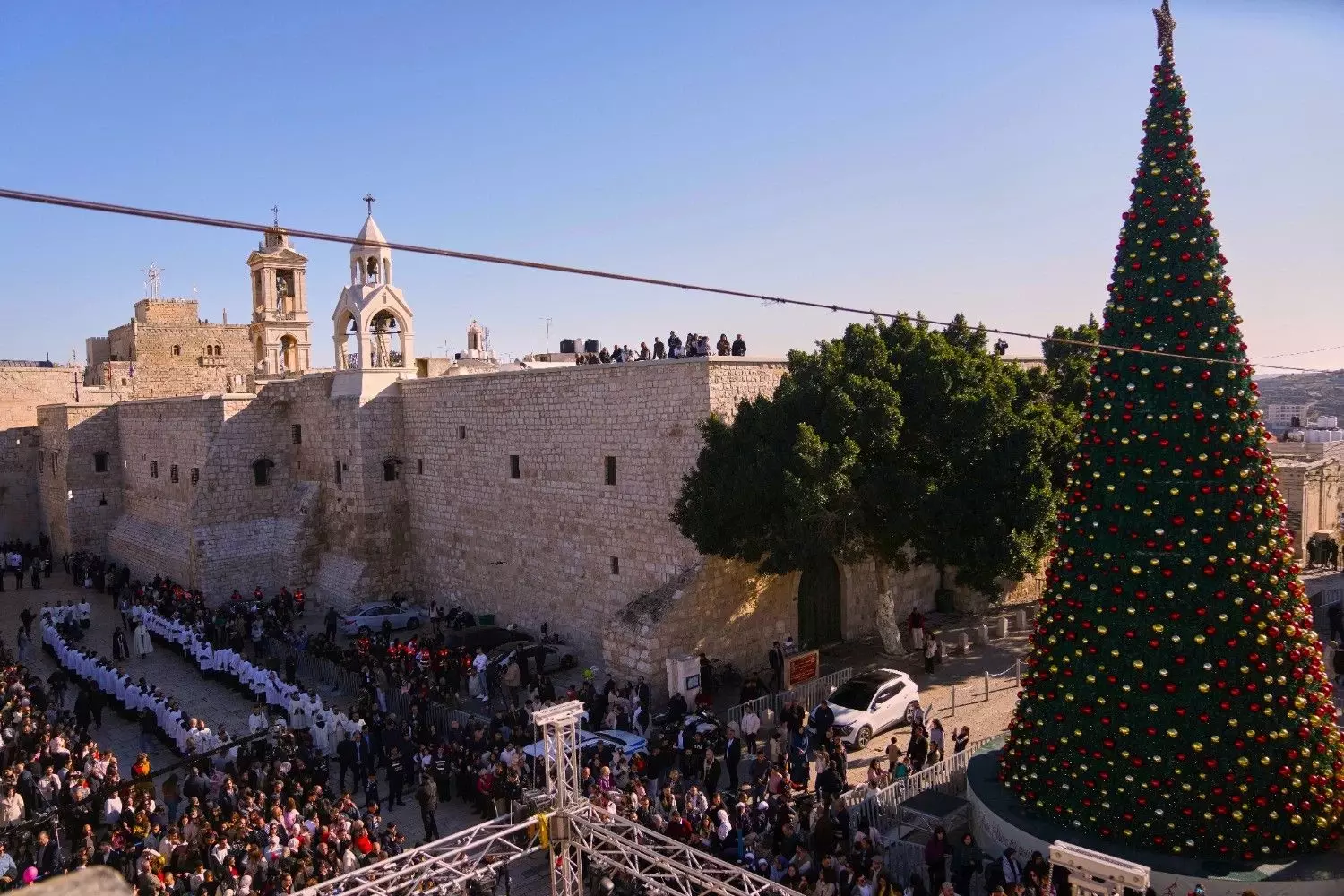
The Holy Family Church in Gaza illuminated its Christmas tree for the first time in two years as the community gathered for Christmas Eve mass. The main prayer hall overflowed with worshippers, many expressing relief and excitement—not only for the holiday, but for having endured another year alive.
The warm glow of decorations around the sanctuary contrasted sharply with the heavy consequences of war that continue to define daily life in the Strip. The parish scaled back festivities this year, focusing celebrations on worship services and short, private family moments. Still, the sound of church bells echoed across the neighborhood, offering a rare emotional lift in a landscape shaped by destruction and uncertainty.
Voices of Loss and a Steady Will to Go On
Among those attending was 58-year-old Dmitri Boulos, who spent the early weeks of the conflict displaced from his home in Tal al-Hawa, south of Gaza City. He and his family initially sought safety at the church, only to find that no location was truly protected.
“The building was struck twice while we were sheltering inside,” Boulos said. “In those days, everything felt flavorless. Fear and grief swallowed every moment. How do you celebrate when the world around you is hurting?”
Boulos expressed a hope shared widely across Gaza: that this Christmas signals a lasting calm and that the year ahead brings fewer barriers and more stability.
Similarly, 32-year-old Nowzand Terzi, who remained outside the church courtyard during mass, described emotional exhaustion that persists long after the worst moments have passed. Terzi lost her home to a strike and later mourned the death of her adult daughter, who became critically ill last year.
“My daughter didn’t reach the hospital in time,” she said quietly, her voice breaking. “I pray for peace—for every family that carries loss, for every soul trying to find steady ground again.”
Another survivor, 18-year-old Edward Sabah, spent more than a year and a half displaced between multiple churches after losing his home in 2023. He was sheltering at Saint Porphyrius Church when an explosion struck the building on October 19, 2023, killing 18 people nearby.
“We were talking like any other evening,” Sabah recalled. “Then came a blast that changed the night in a second. We never imagined a church would be hit, but the war turned every assumption upside down.”
Despite his fears, Sabah said he remains determined to continue his education and eventually complete high school.
“We decorated again this year because we want to live, even when tomorrow feels uncertain,” he said. “I’m holding onto my studies. That’s my path forward now.”
Belonging and the Fight to Protect Normal Moments
Across Gaza, thousands of families continue to struggle with shortages of medicine, food, and basic living resources. Local authorities estimate that more than 288,000 households are facing severe shelter limitations, worsened by ongoing restrictions on humanitarian supplies.
UN data suggests that over 80% of structures in Gaza have been either damaged or destroyed since the war began, forcing mass displacement and reshaping entire districts.
Even in the hardest moments, residents describe a strong emotional bond to their homeland. Many see Christmas not as an escape from reality, but as a declaration that life and culture are still worth defending.
That sentiment was shared by 32-year-old Janet Massadm, who prepared for the holiday by styling her hair and wearing new clothes—her first attempt at celebration since the war began.
“I am deeply drained by what we’ve witnessed,” Massadm said. “But grief has already taken too much. We have to carve out small moments of joy again, even if the world around us is heavy.”
Massadm, displaced from central Gaza’s Remal neighborhood with her parents and siblings, said she hopes the war does not return.
“I wish for families to reunite, for safety to last, and for Gaza to be rebuilt soon,” she said. “Not for me alone, but for everyone who wants to see a future that’s kinder than the past two years.”
A Holiday Defined by Survival, Not Escape
While Wicked may have turned politics into metaphor this year, Gaza’s Christmas story turns survival into its own message. The bells, lights, and crowded pews are not masking the truth—they are proof that the truth did not win.
The magic of the holiday did not erase the hardship. It simply confirmed something stronger:
People here are still choosing life. And choosing hope.