


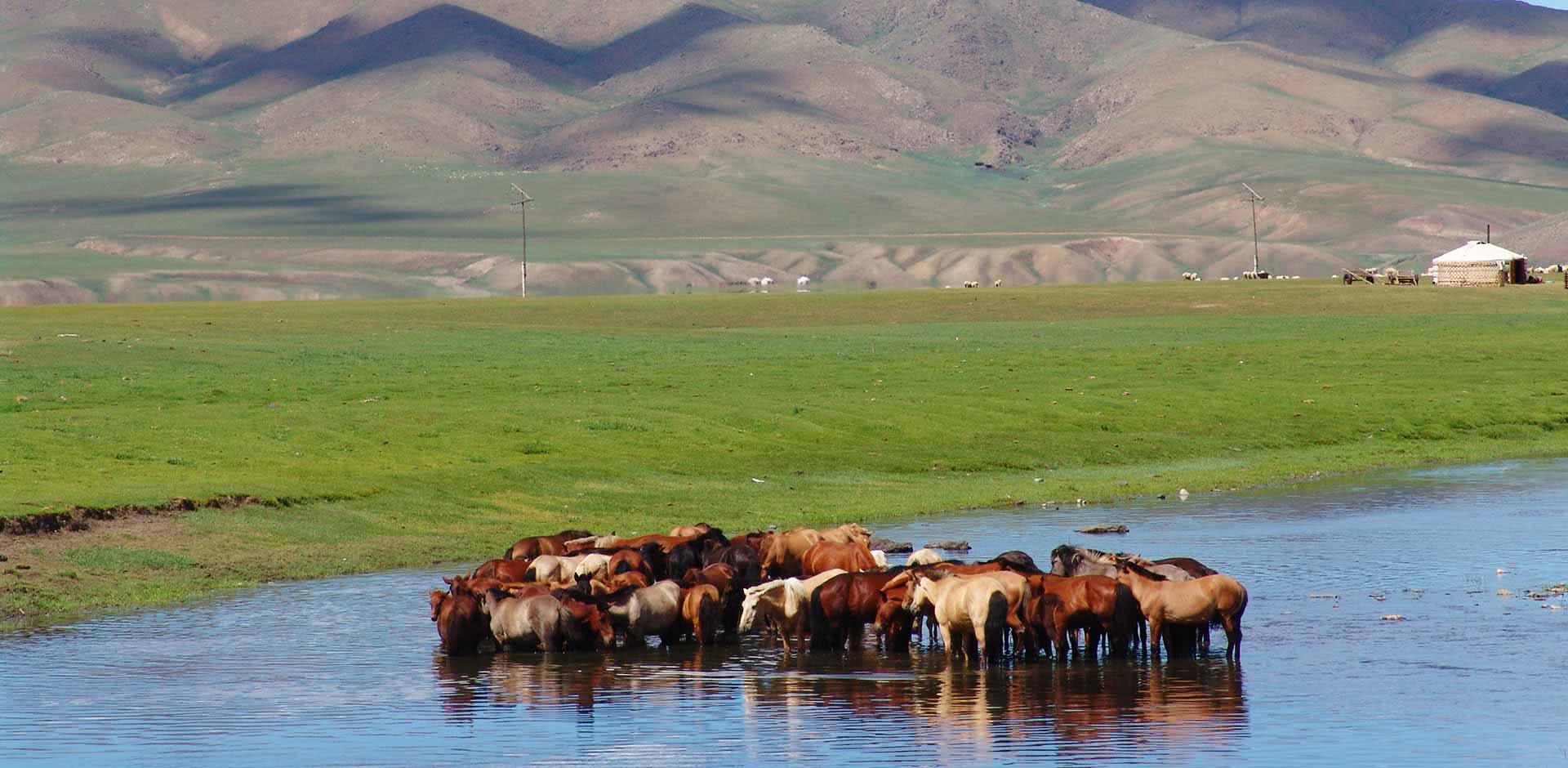
Spring was in full bloom on that warm June afternoon as Yul guided the jeep along the dusty tracks of Hustai National Park. We had barely passed the entrance gates when a massive herd of red deer greeted us, their antlers shining in the gentle sunlight. The vast central Mongolian steppe stretched endlessly around us, dotted with rolling hills covered in vibrant green grass after a long, harsh winter. A soft lavender-like fragrance filled the air, likely from clusters of tiny pink and purple wildflowers blooming freely across the landscape.
Unexpected Wildlife Encounters
Yul, my local driver, was a man of few words but expressive smiles and animated gestures—greatly helped by his impressive command of Google Translate. When he suddenly hit the brakes, I glanced out, hoping to spot the wild horses we were searching for. Instead, he pointed to two round, furry marmots rising from their burrows like guards of a hidden underground kingdom. One glared at us disapprovingly before disappearing back into its hole.
Nice, but still no horses.
First Glimpse of the Takhi
Just as I began to worry, Yul stopped near a pair of park rangers who were peering through a telescope. High on a distant slope stood a herd of takhi. Yul explained that it was likely a family group: one dominant stallion watching over a cluster of mares and their foals, while unattached males wandered in looser groups—perhaps, as Yul joked, “heading to the Friday-night bars.”
Through the telescope, the tiny black dots slowly sharpened into silhouettes of stocky, powerful horses—my first real takhi sighting.
Waiting for the Horses to Descend
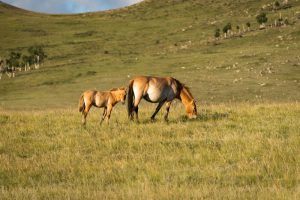
To my dismay, Yul started driving away, but he reassured me to be patient. The horses would eventually come down to drink when the air cooled. And he was right. As the evening settled in, the herd moved down the slope in a regal procession before breaking into a spirited gallop toward a nearby stream. We watched quietly from afar, careful not to disturb them with our excitement.
Why Travel So Far to See Wild Horses?
Yul seemed amused by our enthusiasm—understandably so. During the drive from Ulaanbaatar to our ger camp, we had already passed countless horses grazing freely along the roadside. Why venture deep into the park just to see more?
But Hustai National Park, or Khustain Nuruu, is no ordinary place. It is the ancestral home of the takhi—the short, muscular Mongolian wild horses with tan coats, white muzzles, and dark “stockings” on their legs. Unlike domestic horses, takhi have never been bred or tamed by humans. Their very existence today is a miracle.
The Remarkable Return of the Takhi
Known internationally as Equus przewalskii—after the Russian explorer Nikolai Przewalski—the takhi once roamed Mongolia widely. But they were hunted for meat and pushed out by domestic horses. By the late 1960s, the takhi had completely disappeared from their natural habitat.
Their comeback story began in 1992 when 15 takhi were brought back to Mongolia. The government established a 506-square-kilometer protected reserve managed by the Hustai National Park Trust. Thanks to sustained conservation efforts, the population has grown to more than 400 takhi, sharing the landscape with 55 species of mammals and over 220 bird species.
A Rare Conservation Success
I had been captivated by this rewilding story ever since a photographer friend told me about it years ago. Mongolia has achieved something extraordinary: reviving a native species that was once extinct in the wild. Challenges remain, such as preventing domestic horses from entering the park to avoid competition and interbreeding, and managing threats like disease and predatory wolves.
A Moment of Quiet Realization
As I lifted my gaze from these thoughts, the takhi were right there—grazing peacefully, seemingly unbothered by the world’s troubles. Their muddy coats and large heads may not win beauty contests, but their resilience is breathtaking.
May their herds continue to thrive for generations to come.